Lines in the Sand

-
-
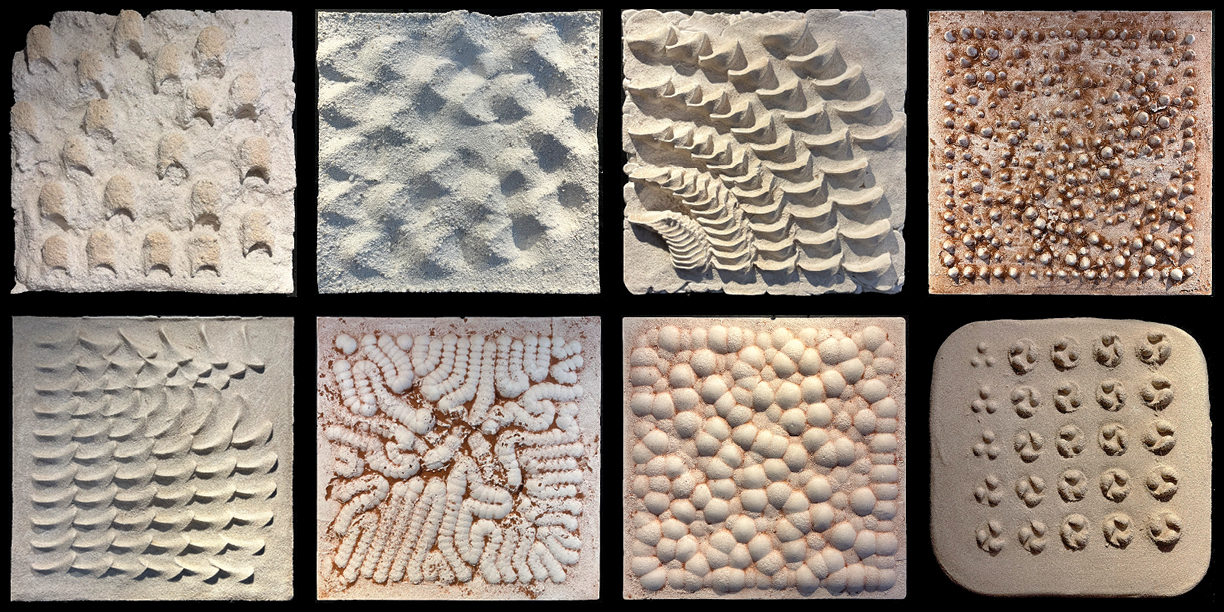
Images created by Andrea Brucato, Alex Merritt, Ayla Browne, Blake Kierstead, Brogan McCormick, Brooke Premont, Devon Thibodeau, Emma Pelletier, Gavin Green, Jamie Fenoff, Jesse Harmon, Jade Jimenez, Molly Crawford, Mykel Fungi, Nadalia McLeary, Oliver Meyo, Riyam Al-Janabi, Dusty Philman, Stephanie Unuane, and Teresa Esabunefe
Chameleon: What sparked your interest in the technological side of architecture?
Seibold: I came to the technological side of architecture in a roundabout way through an interest in hands-on making. As an undergraduate architecture student, I was drawn to full-scale work and design-build projects. I hand-drew everything, and my process was very analog. What fascinated me most wasn’t just the final product, but the process and craft of making itself.
At the time, the early 2000s, digital tools didn’t feel very connected to the material, physical side of design. But less than a decade later, architecture schools started to fill with new tools—laser cutters, 3D printers, CNC machines—sitting right alongside the woodshop. That caught my attention.
I decided to go back to graduate school to study design and technology, and that’s where I really developed an interest in digital fabrication. My curiosity about technology has always been rooted in making—understanding how these tools work and how they can expand the ways we design and build.
Chameleon: Can you summarize the catalyst for Lines in the Sand?
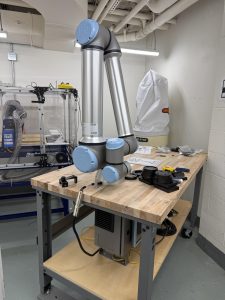
Seibold: Lines in the Sand asked students to design and fabricate 12″×12″ plaster wall panels using a robotic arm to inscribe toolpaths into beds of sand. Each student group worked with a different type of sand, which responded to physical inputs in unique ways. The toolpaths, designed by student teams and executed by the robot, become surface reliefs once cast in plaster. The project explored how digital precision meets material unpredictability. The outcome was both a physical artifact and a study in how design intent shifts when filtered through material behavior. Each panel belongs to two worlds: the precise digital command and the imprecise physical world.
Chameleon: How did you come up with this project and set the parameters? What was your approach to guiding students through their design?
Seibold: Conceptually, this project comes from a broader interest in the role of digital fabrication in a design context. It can move beyond simply making things faster or more precisely—it can also be a space for creative experimentation. Why do we have digital fabrication tools at the School of Architecture + Art? On one hand, these digital tools let us do familiar things (make scale models, cut materials), but on the other hand, they can also reshape how we think and design. That’s the more interesting territory for me: treating fabrication tools not as rigid instruments, but as active participants in the design process.
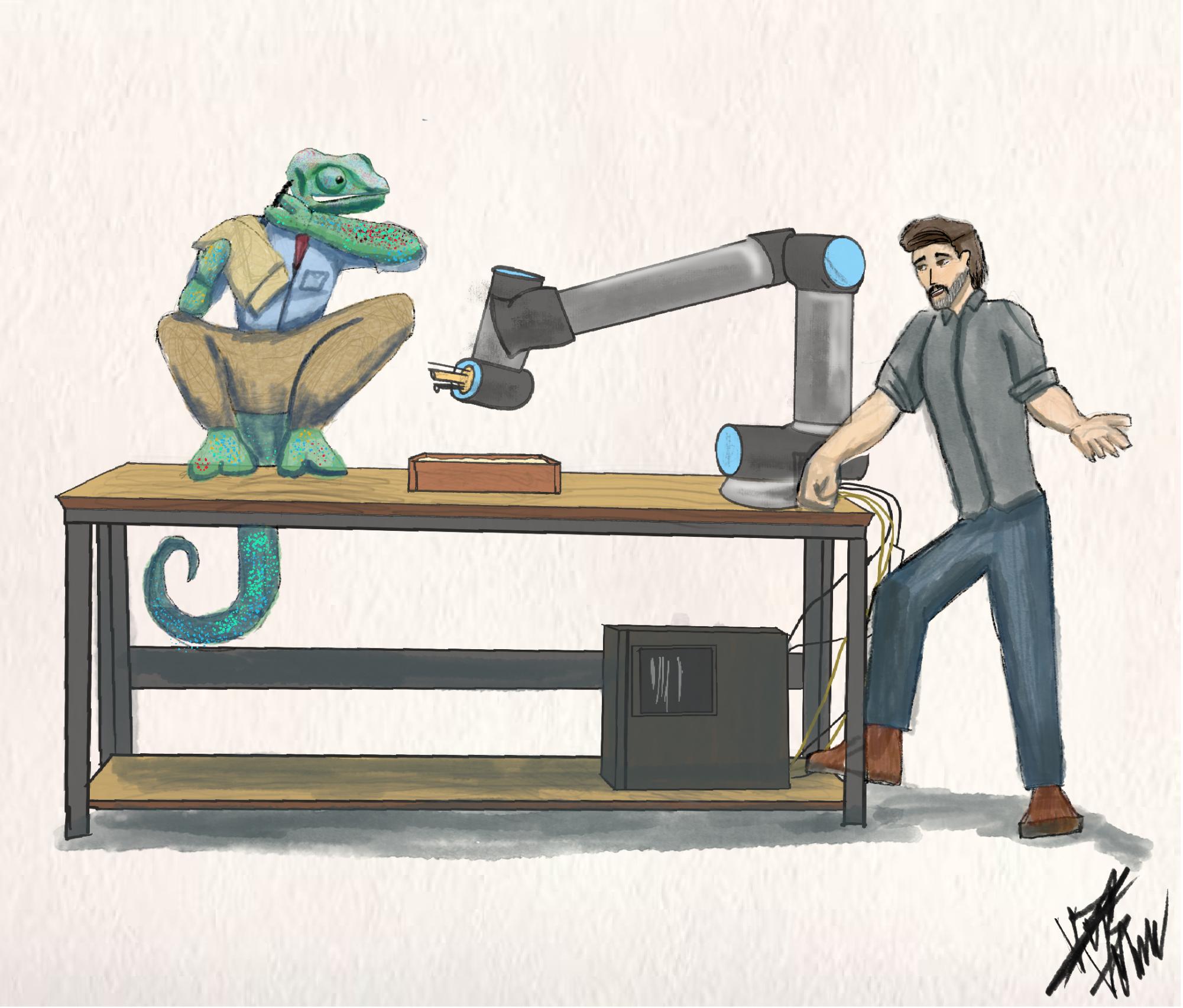
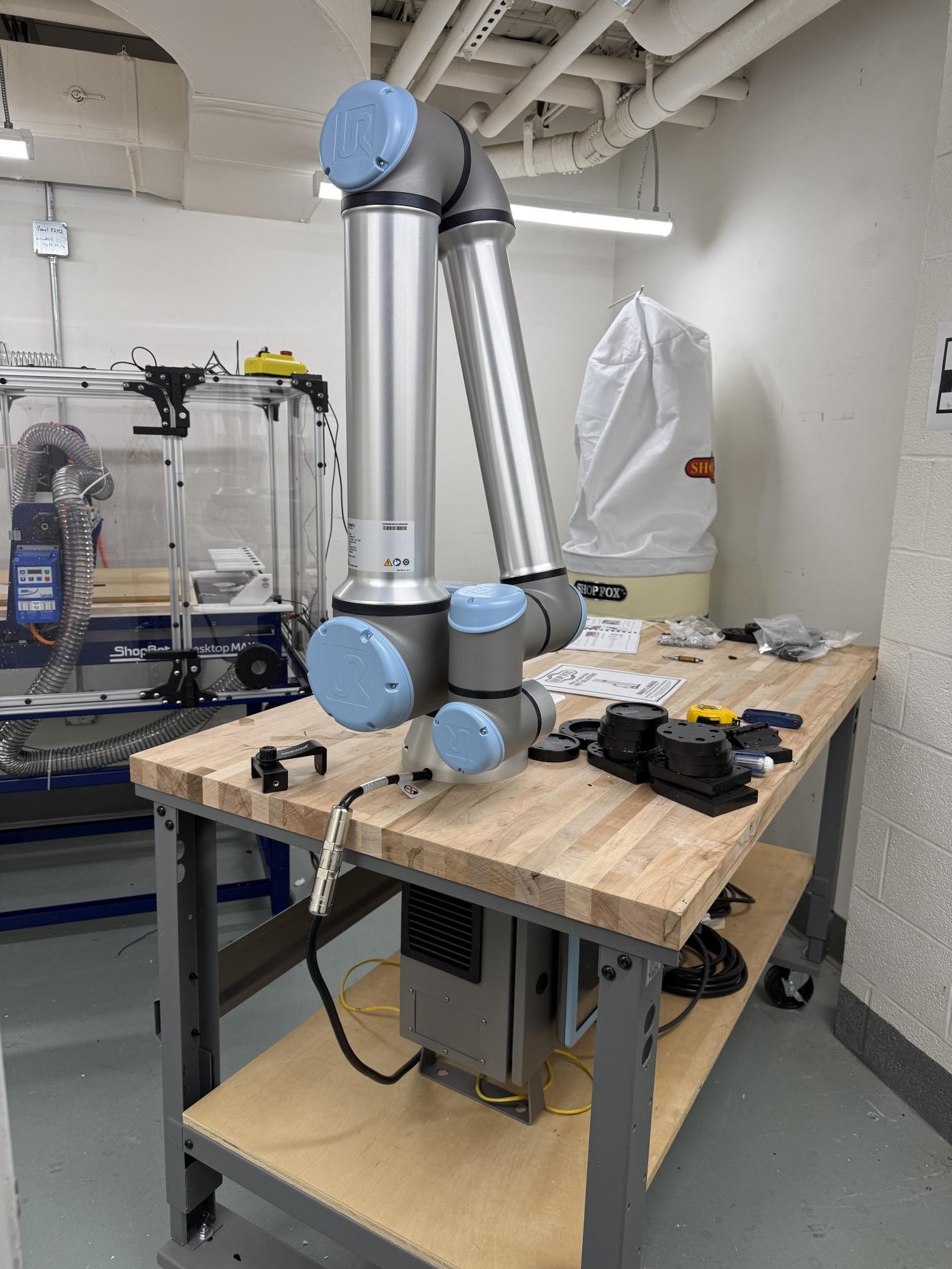
Practically, the project arose from an opportunity. The School of Architecture + Art recently received a robotic arm as part of the Cyber Institute grant, and I wanted to use the AP411 catalyst project to introduce this new piece of equipment to the school. Since it only arrived a couple of weeks before the start of the semester, the setup had to be simple and fast. The project needed to be inexpensive, achievable in a short duration (two weeks), and structured for teamwork. Each group member could take on a distinct role: developing the robotic toolpath, designing the toolhead, refining the material, or managing the casting process.
Sand was an ideal medium: familiar, tactile, forgiving, and responsive. Students could quickly develop iterations and refinements to their robot motion design. Even when the robot’s movement wasn’t perfect, the material produced intriguing results. It also tied into a familiar workflow—casting plaster—so students could build on existing skills while exploring something new. Starting the semester with an elemental material like sand felt like the right way to begin a conversation about material behavior, digital tools, and the creative potential that lies between them.
Chameleon: What were your initial thoughts when you saw each student’s finalized tiles, and what are your thoughts now on the finished product, given some time to reflect on the process/result?
Seibold: I was impressed by how distinct each group’s panels were! No two are the same. That variation is exactly what I hoped for; it showed that students were engaging critically with material feedback rather than just executing instructions. Reflecting on Lines in the Sand now, I think the real success lies in how the process required students to be comfortable with uncertainty. The finished collection of panels reads like a physical record of learning.
Chameleon: What do you hope the public will get out of these tiles?
Seibold: There’s a great quote from the architect Cedric Price: “Technology is the answer, but what was the question?” That’s always in the back of my mind when developing projects such as this. It’s easy to get excited about a new robot, but ultimately, it’s just a tool—the real question is how do these tools inform the way we learn, design, and make. Additionally, it’s important that the work addresses questions that are focused and discipline-specific yet remain accessible and relevant to a general audience.
So, the project works on several levels. On one hand, it’s about sustainability—the sand serves as a reusable, reconfigurable mold, eliminating the waste associated with single-use formwork. Most people are familiar with casting concrete, so it’s accessible to see how a robot can intervene in that familiar process to add creative and material value.
More broadly, I hope the project shows that architectural education isn’t only about finished buildings—it’s about learning through making, through process, failure, and curiosity. The tiles show that technology in architecture isn’t sterile or mechanical; it’s deeply human. Each panel captures a negotiation between digital precision and the unpredictability of material behavior.
Chameleon: Do you foresee this robot arm project becoming a recurring cast member in future catalyst seasons? What variation can we expect in the project outline?
Seibold: Absolutely! The robot is a great way to connect various threads in architectural education—digital design tools, fabrication, design thinking––in a tangible, experiential way. The questions we’re exploring are not medium or process-specific. The robot is simply a tool that moves another tool in a precise and repeatable way.
Future iterations will likely make use of more sophisticated workflows on the robot, which are currently under development, such as 3D printing with clay or using actuated tools like a gripper for pick-and-place operations. That said, the sand-casting project itself still has a lot of room for evolution and experimentation.
Chameleon: How would you expect students to use this robot arm in their architecture projects, as it pertains to model making?
Seibold: Model making can mean many different things in the context of architecture school. We often make scale models to communicate design intent—complementing what drawings or renderings can show. But we can also work on a 1:1 scale to test material behavior, connection details, or fabrication techniques.
I see the robot’s capacities more closely aligned with this second mode of making. In that sense, it becomes a tool for prototyping processes rather than producing representations. Students can use it to explore material systems, test assembly strategies, or develop performative surfaces that respond to specific design goals.
NOTE: The images in the sand were created by Andrea Brucato, Alex Merritt, Ayla Browne, Blake Kierstead, Brogan McCormick, Brooke Premont, Devon Thibodeau, Emma Pelletier, Gavin Green, Jamie Fenoff, Jesse Harmon, Jade Jimenez, Molly Crawford, Mykel Fungi, Nadalia McLeary, Oliver Meyo, Riyam Al-Janabi, Dusty Philman, Stephanie Unuane, and Teresa Esabunefe.
Your donation will support the student journalists of Norwich University. Your contribution will allow us to purchase equipment and cover our annual website hosting costs.